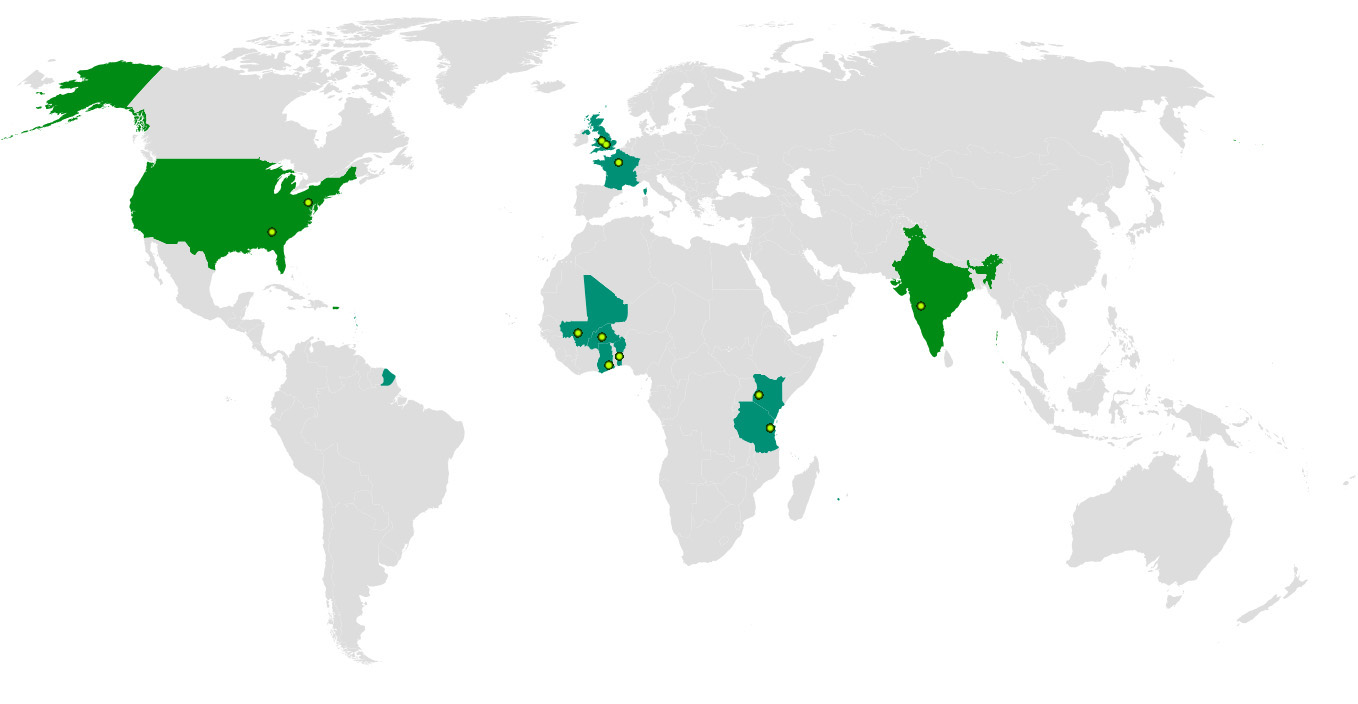
The French National Research Institute for Sustainable Development (IRD) is a public scientific institution dedicated to fostering international partnerships for global development. It focuses on addressing major environmental, health, and social challenges across tropical and Mediterranean regions.
The Université de Sciences, Techniques et Technologies de Bamako (USTTB) is Mali’s leading institution for biomedical research. Through its Parasites & Microbes Research & Training Center (PMRTC), it provides the Scientific Leadership for the PfVIMT clinical trials. The USTTB team, led by Professor Issaka Sagara, is responsible for implementing the vaccine protocols designed to break the cycle of malaria transmission.
The Ifakara Health Institute (IHI) is a leading Tanzanian health research organization recognized globally for its excellence in biomedical and environmental research. As a key partner in the PfVIMT consortium, IHI provides critical expertise in conducting high-impact clinical trials. The institute is dedicated to developing and testing innovative tools, such as transmission-blocking vaccines, to improve public health and eliminate malaria across Africa.
Imperial College London is a world-class university specializing in science, engineering, medicine, and business. As a key partner in the PfVIMT consortium, Imperial provides essential expertise in mathematical modeling and immunology. Its contribution is vital for predicting the impact of transmission-blocking vaccines and understanding the immune response required to break the malaria cycle.
The Clinical Research Institute of Benin (IRCB) is a leading scientific center dedicated to advancing clinical research and public health in West Africa. As a crucial partner in the PfVIMT consortium, IRCB provides world-class expertise in pediatric clinical trials and parasite immunology. Its mission within the project focuses on evaluating the safety and efficacy of transmission-blocking vaccines in the field to help eradicate malaria.
The Groupe de Recherche Action en Santé (GRAS) is a leading Burkinabé research institute dedicated to clinical excellence and public health innovation. Within the PfVIMT consortium, GRAS plays a vital role in conducting large-scale clinical trials and epidemiological monitoring. Their expertise in the field is essential for evaluating the effectiveness of new transmission-blocking vaccines in real-world conditions.
The Kenya Medical Research Institute (KEMRI) is a leading center for excellence in health research in Africa and globally. Within the PfVIMT consortium, KEMRI brings unparalleled expertise in clinical trials and field-based malaria research. Its state-of-the-art facilities and dedicated research teams are instrumental in assessing the real-world impact of transmission-blocking vaccines, ensuring that scientific innovations translate into effective public health solutions for local communities.

The Noguchi Memorial Institute for Medical Research (NMIMR) is Ghana’s leading biomedical research facility and a center of excellence in the African region. As a vital partner in the PfVIMT consortium, NMIMR provides high-level expertise in parasitology and vaccine immunology. The institute plays a key role in monitoring the efficacy of malaria interventions and conducting clinical evaluations to support the development of next-generation transmission-blocking tools.

The University of Oxford is a global leader in medical research and vaccine development. As a cornerstone of the PfVIMT consortium, Oxford’s Jenner Institute provides the cutting-edge technology and clinical expertise behind the R21 and Pfs230D1 vaccine candidates. Its role is fundamental in bridging laboratory innovation with large-scale clinical impact, driving the scientific efforts to finally break the cycle of malaria transmission worldwide.

The National Institute of Allergy and Infectious Diseases (NIAID), part of the U.S. National Institutes of Health (NIH), contributes to PfVIMT through the Laboratory of Malaria Immunology and Vaccinology (LMIV), led by Dr. Patrick Duffy. As LMIV Chief, Dr. Duffy directs NIAID’s intramural malaria vaccine program and has extensive experience leading malaria studies and mentoring scientists in the US and Africa. LMIV focuses on malaria pathogenesis, immunity, and vaccine development, and has developed the first malaria transmission-blocking vaccines to enter field trials, partnered with Sanaria on the first field efficacy trials of whole-organism malaria vaccines, and pioneered, with collaborators in Mali, vaccines to prevent malaria in pregnancy.
The LMIV team supporting PfVIMT includes a study clinician, staff scientists, a data manager, a scientific writer, a project manager, and a statistician. Together, they advanced the Pfs230D1 transmission-blocking vaccine from discovery to clinical development and now support its combination with R21 and evaluation in the pivotal field trials funded by PfVIMT.
The Centers for Disease Control and Prevention (CDC) is a world-leading national public health agency. Its Division of Parasitic Diseases and Malaria brings decades of experience in field implementation and surveillance to the PfVIMT project. As an associated partner, the CDC provides critical strategic support and technical expertise in monitoring the epidemiological impact of transmission-blocking vaccines, ensuring that the consortium’s research meets the highest global public health standards.
The Serum Institute of India (SIIPL) is the world’s largest vaccine manufacturer by number of doses produced and sold globally. As a vital associated partner of PfVIMT, SIIPL is the primary manufacturer of the R21/Matrix-M malaria vaccine. Its large-scale production capacity and commitment to affordable healthcare are essential for ensuring that transmission-blocking vaccines are accessible and deployable across malaria-endemic regions.